Cause reference
Widespread Fungal Soiling Losses
Engineering Reference
Field Signature
Fungal bio-soiling is persistent biological contamination on module glass. It can remain after rainfall and create losses that are easy to misclassify as ordinary dust, pollen, or a weather-normalization error.
The Solar Unsoiled report for the 2026 kWh Analytics Solar Risk Assessment highlights this issue in humid subtropical U.S. climates. It notes that 2024 field work by Solar Unsoiled, the National Laboratory of the Rockies, and Duke University found persistent solar-farm losses in North Carolina that could only be recovered through manual cleaning.
Those persistent losses were reported at 5-11%. They were initially attributed to pollen, but the research points to a different culprit: sub-aerial biofilms and persistent bio-soiling.
Loss Mechanisms
Solar Unsoiled, NLR, and Duke identified sub-aerial biofilms and specifically black fungi as the main driver of persistent bio-soiling. As these organisms grow on the module surface, they form dark masses and attract other particles. That lowers glass transmittance and can create a soiling loss that changes dynamically over time.
The report distinguishes this behavior from conventional dust. Ordinary dust may partly wash off during rainfall, while fungal bio-soiling can remain attached to the glass until targeted cleaning removes it.
Field Evidence
Solar Unsoiled's patent-pending method directly images the module surface with handheld digital microscopes and has been applied to more than 15 GW of PV assets. In the cited 50,000-image dataset, bio-soiling was identified across eight Koppen-Geiger climate zones.
The report states that surface coverage averaged 3.2 +/- 4.9%, with observed coverage ranging from 0.2% to 34%.
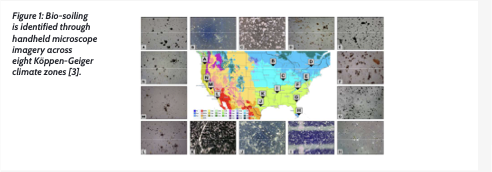
Figure 1: Bio-soiling identified through handheld microscope imagery across eight Koppen-Geiger climate zones.
Financial Impact
To estimate financial exposure, the team analyzed bio-soiling across the humid subtropical climate zone. The report states that the average annual bio-soiling loss, extrapolated from more than 120 cleanings of operational solar farms in the region, was 5%.
Using that 5% loss, about 82,000 MW of installed solar capacity in the Cfa climate zone, an average yield of about 1,600 MWh/MW/year, and a PPA price of $50/MWh, the report estimates annual revenue loss from bio-soiling at about $330 million in the humid subtropical climate zone alone.
The report also notes that California and the desert Southwest were previously assumed to have minimal or zero soiling losses in production forecasts. Without cleaning integrated into maintenance budgets, many sites can underperform when persistent bio-soiling is present.
Diagnostic Workflow
Start with rainfall and cleaning response. A persistent normalized-production deficit that does not recover after rain but improves after manual cleaning supports biological soiling rather than ordinary dust.
Use close field inspection or handheld microscopy when the contaminant type matters for cleaning method, recurrence risk, or forecast updates. Biological deposits can be patchy, so site walks should include multiple array areas and not rely on a single representative module.
Compare cleaning records against SCADA, irradiance, and weather-normalized production. The key evidence is a repeatable production step-change after cleaning, especially where rainfall had not restored the expected output.
Engineering Notes
Fungal bio-soiling changes the cleaning economics. If a site has persistent deposits, cleaning should be treated as a necessary maintenance action rather than an optional response to visible dust.
For underwriting and asset management, include bio-soiling in production-loss assumptions where humid climate, vegetation, water proximity, or field evidence suggest recurrence. Update forecasts using site cleaning results rather than assuming rainfall resets the loss.
References
- Michael Valerino, Solar Unsoiled, "Widespread Fungal Soiling Causing 5% Loss in the Humid Subtropical U.S. Alone", kWh Analytics Solar Risk Assessment, 2026.
- G. E. Bessa et al., "An investigation on the pollen-induced soiling losses in utility-scale PV plants," IEEE Journal of Photovoltaics, vol. 14, no. 1, pp. 178-184, Jan. 2024.
- H. E. Beck et al., "High-resolution (1 km) Koppen-Geiger maps for 1901-2099 based on constrained CMIP6 projections," Scientific Data, vol. 10, no. 1, p. 724, Oct. 2023.
- A. Rivera et al., "Persistent Soiling: The Widespread Impact of Fungal Bio-Soiling on Photovoltaic Energy," 2026. Manuscript submitted for publication.